
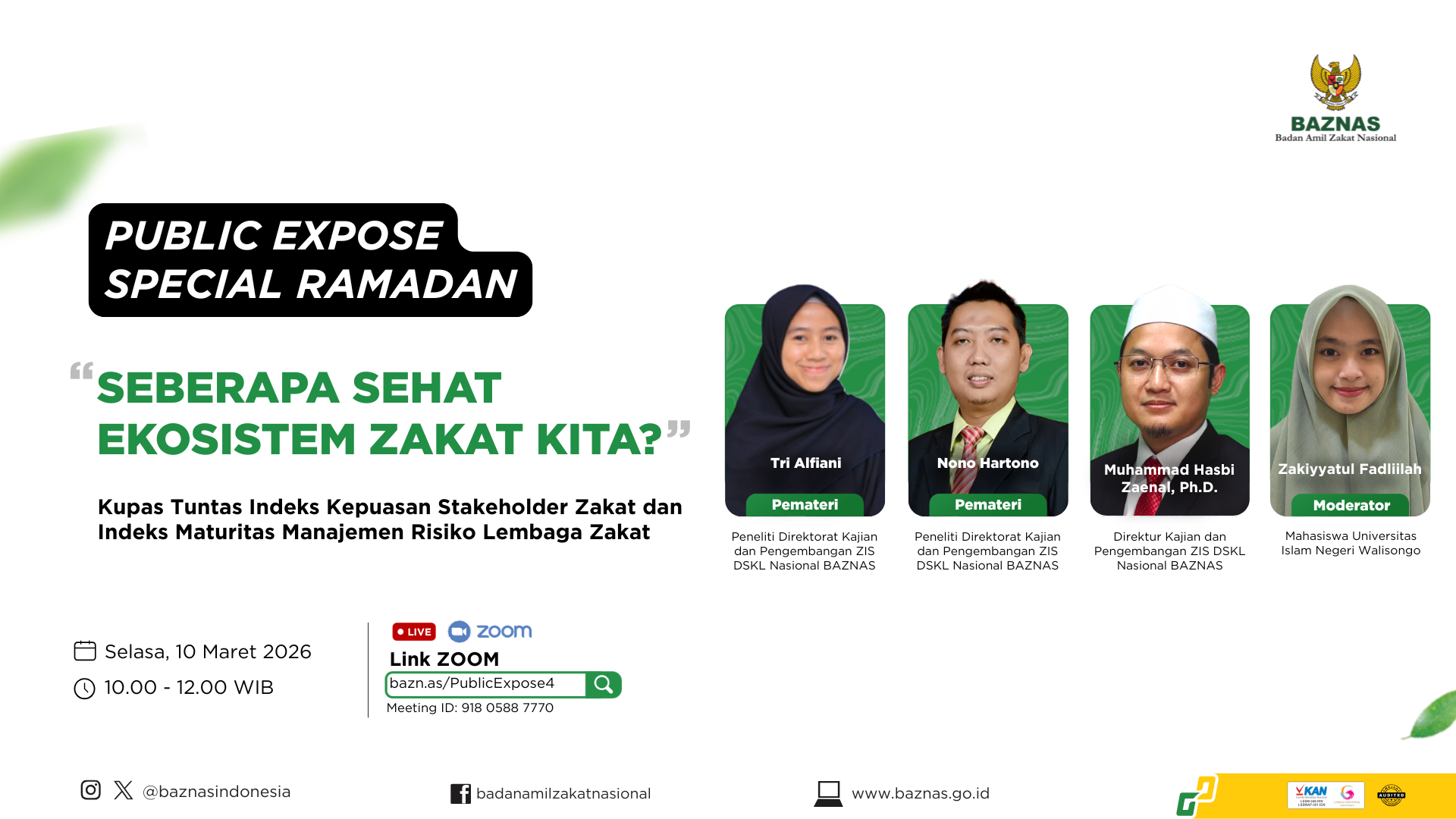
Jakarta, March 10, 2026 - The National Amil Zakat Board (Badan Amil Zakat Nasional/BAZNAS), through its Directorate of ZIS-DSKL Studies and Development, organized the 4th Series of Public Expose under the theme "How Healthy Is Our Zakat Ecosystem?" The event was held online and attended by the Chairpersons of Provincial, Regency, and Municipal BAZNAS branches; Directors of National, Provincial, and Regency/Municipal Zakat Management Organizations (LAZ); as well as researchers, academics, and students.
The event was moderated by Zakiyyatul Fadliilah, a student from Walisongo State Islamic University (UIN Walisongo), who is currently undertaking an internship program at the Directorate of ZIS-DSKL Research and Development of the National BAZNAS.
The objective of this Public Expose was to present research findings while strengthening the understanding of the health of Indonesia's zakat ecosystem particularly with regard to the maturity of risk management within zakat institutions, as well as the level of stakeholder satisfaction with zakat governance and administration.
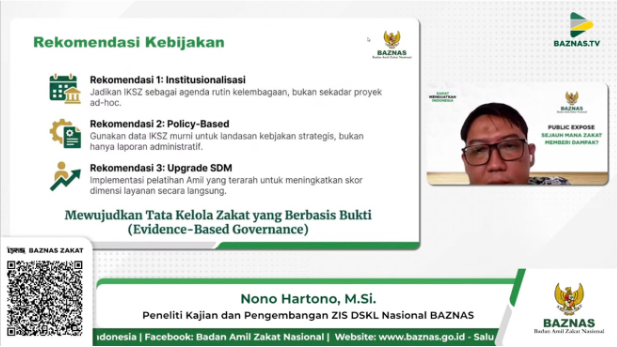
The first presentation covered a study on the Zakat Stakeholder Satisfaction Index, delivered by Mr. Nono Hartono, M.Si., a Researcher at the Directorate of ZIS-DSKL Studies and Development of the National BAZNAS. The study highlighted that a healthy zakat ecosystem is not measured solely by the volume of zakat collection and distribution, but also by the level of satisfaction and trust among its stakeholders. The Index was constructed across several key dimensions, namely: coordination and participation, service and accessibility, transparency and accountability, and the impact of zakat programs.
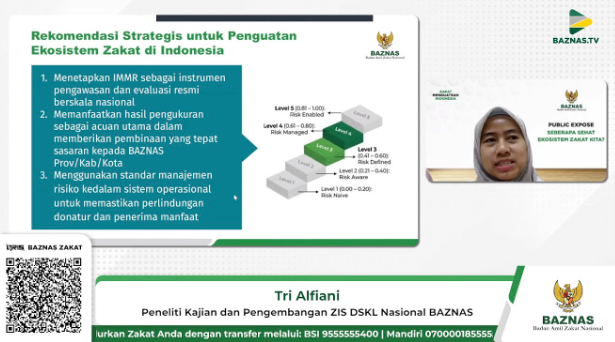
The second presentation covered a study on the Risk Management Maturity Index, delivered by Ms. Tri Alfiani, MIFP, a Researcher at the Directorate of ZIS-DSKL Studies and Development of the National BAZNAS. The study discussed the notion that a healthy zakat institution is not one that is free from risk, but rather one that is capable of managing risk in a systematic and measurable manner. The Index was designed to map the level of risk management maturity within zakat institutions ranging from the initial stage through to full integration into strategic decision-making thereby serving as a benchmark for the professionalism and sustainability of zakat organizations.
Through this Public Expose, BAZNAS expressed its hope that the research findings presented would serve as a strategic foundation for strengthening national zakat governance, while also providing valuable insights for zakat administrators and the wider public in realizing a zakat ecosystem that is increasingly professional, transparent, and integrity-driven.